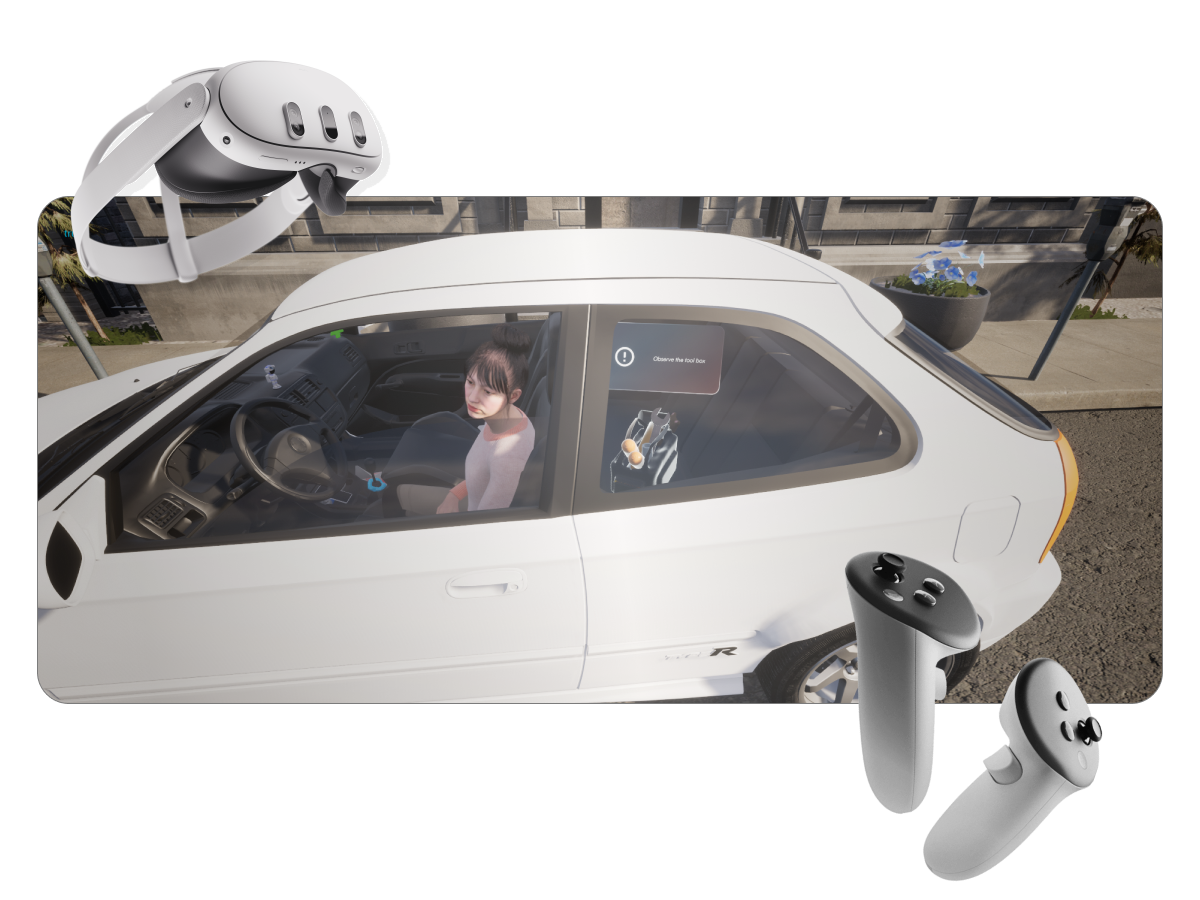
VR Training Platform for Minnesota's Law Enforcement Trainees
Built in Unreal Engine 5, NextGen Badge creates a safe, repeatable space for law-enforcement trainees to test both technical skills and emotional resilience.
The platform addresses a critical gap in traditional police training: the inability to practice high-stakes scenarios safely and repeatedly. Through immersive VR experiences, trainees can encounter realistic situations, make decisions under pressure, and learn from mistakes without real-world consequences.
My role: Designed the user interface, interaction patterns, and user experience flows for the VR training platform, ensuring intuitive navigation and effective learning outcomes.
TL;DR
Problem
Traditional police training lacks safe, repeatable environments for high-stakes scenario practice.
Approach
VR/XR design, user research with law enforcement trainees, iterative prototyping in Unreal Engine 5.
Solution
Immersive VR training platform with realistic scenarios, intuitive UI interactions, and comprehensive feedback systems.
Impact
Enabled safe, repeatable training scenarios. Improved trainee confidence and decision-making skills in high-pressure situations.
Project Overview
NextGen Badge represents a breakthrough in law enforcement training, leveraging VR technology to create immersive learning experiences. The platform allows trainees to practice critical decision-making, de-escalation techniques, and tactical responses in a controlled, safe environment.
Key Features
- Realistic Scenarios: High-fidelity VR environments that replicate real-world situations
- Interactive UI: Intuitive interface design for seamless navigation in VR space
- MetaHuman Integration: Realistic character interactions for authentic training experiences
- Performance Tracking: Comprehensive analytics and feedback systems
- Tool Bag System: Contextual tools and resources accessible during training
Design Process
The design process involved extensive collaboration with law enforcement professionals to understand training needs, pain points, and learning objectives. Early prototypes were tested with trainees to refine interaction patterns and ensure usability in VR environments.
User Flow & Interactions
The user flow was designed to guide trainees through scenario selection, preparation, execution, and review. Each interaction was carefully crafted to feel natural in VR while maintaining clarity and purpose.
Visual Design
The visual design balances realism with clarity, ensuring that UI elements are visible and functional in immersive VR environments. Color choices, typography, and spatial design were optimized for VR viewing and interaction.
Tool Bag System
The Tool Bag system provides contextual access to resources and tools during training scenarios. The design ensures quick access without disrupting the immersive experience.
Video Demonstrations
The platform includes video demonstrations showcasing UI interactions, MetaHuman character selection, and level portal navigation.